


Southwest Florida Hurricane Guide · Generators
Southwest Florida Generator Safety: Hurricane Preparedness Tips for Homeowners
How to run a portable generator safely after a hurricane in Southwest Florida, what a standby generator involves, carbon monoxide rules, permits and maintenance.
After Hurricane Ian in 2022, parts of Fort Myers and Cape Coral went more than a week without power. A generator can keep the refrigerator, fans, lights and medical equipment running until service returns, but only if it’s set up and used safely. This guide covers portable and standby generators, carbon monoxide safety, connecting a generator to your home, and maintenance. It’s part of our Southwest Florida Hurricane Preparedness Guide.
Key Takeaways
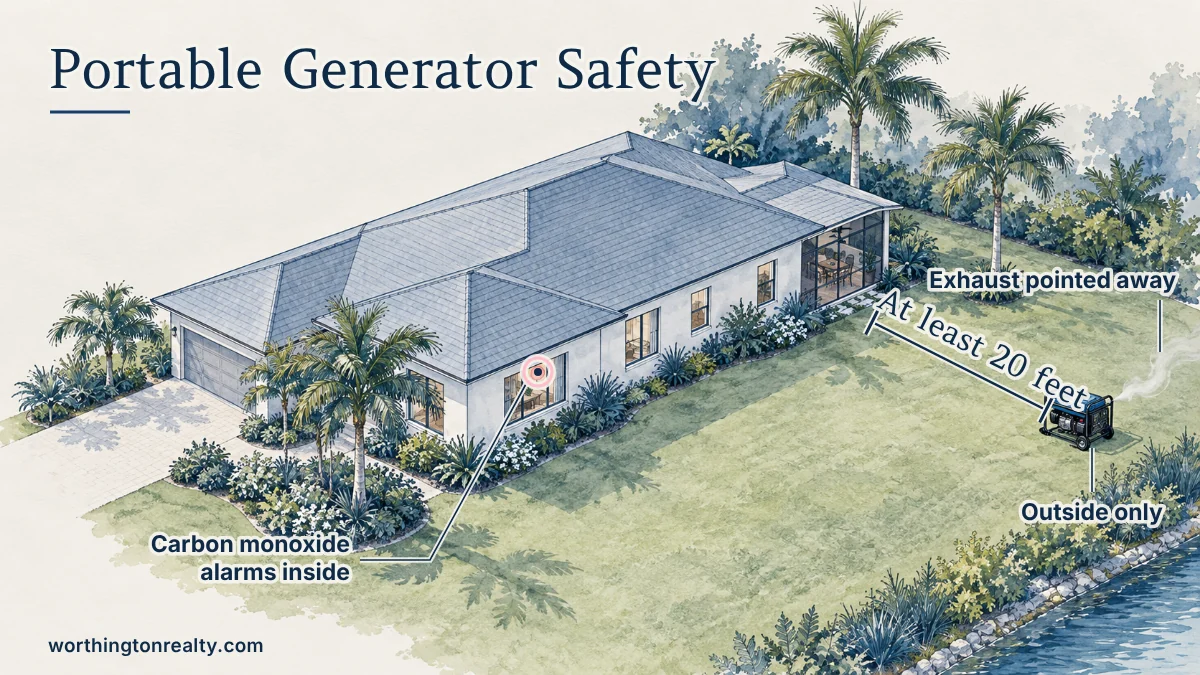
- Run a portable generator outside only, at least 20 feet from your home and other buildings, with the exhaust pointed away from doors, windows and vents. Never run one in a garage, lanai or shed.
- Put battery-powered carbon monoxide alarms inside the home.
- Never plug a generator into a wall outlet. Powering household circuits takes approved transfer equipment installed by a licensed electrician with the required permit.
- A standby generator is a permanent installation with its own permits, setbacks and fuel requirements.
- Follow your generator’s manual for maintenance, test runs and fuel storage.
Portable or Standby?
| Type | What it powers | What it takes |
|---|---|---|
| Portable | The appliances you plug into it with outdoor-rated cords, or selected circuits through a transfer switch or interlock | Fuel on hand, a safe outdoor spot, and someone to start, refuel and watch it |
| Standby | Selected circuits or more of the home, depending on its size and how it’s wired | A permanent pad, a licensed installer, permits, an approved fuel supply (commonly natural gas or propane), and HOA approval where required |
A standby generator powers only what it’s sized and wired for, so ask the installer to list the circuits it will run.
Carbon Monoxide Safety
Generators make carbon monoxide, which you can’t see or smell. The CDC advises running portable generators outside, more than 20 feet from windows, doors and vents. Keep them at least 20 feet from the house and other buildings, with the exhaust pointed away. Open windows and doors don’t make a garage or lanai safe.
- Install battery-powered or battery-backup carbon monoxide alarms on each level of the home and outside sleeping areas.
- Point the exhaust away from your home and your neighbors’ homes.
- If anyone feels dizzy, sick or weak, get everyone outside to fresh air and call 911.
Connecting a Generator to Your Home
Never plug a generator into a household outlet. That’s called backfeeding, and it can send power back through the lines and injure utility crews or your neighbors. To run household circuits, have a licensed electrician install approved transfer equipment with the permit your city or county requires. A listed interlock that fits your electrical panel may be an option where your building department allows it. If someone in the home relies on medical equipment, confirm its power needs with the equipment supplier and keep a backup plan, such as a place to go, in case the generator can’t run it. For individual appliances, use heavy-duty, outdoor-rated extension cords sized for the load.
Before the Season
- Read the manual and follow its schedule for test runs, oil changes and filters.
- Follow the manual’s test-run procedure to make sure it works.
- Store fuel in approved containers, outside the living area and away from anything that could ignite it, such as a water heater in the garage. Follow the manual’s instructions for fuel age, stabilizer and storage, and use propane or natural gas only in units built for them.
- List the appliances you’ll power and check both their running watts and their starting watts, so you stay within the generator’s rated capacity.
- Know where the generator will sit: on a dry, level surface, away from the house and out of standing water.
A generator needs regular upkeep if you want it to work when you need it. I never leave old fuel sitting in the tank. That’s how you get a gummed-up engine. Before hurricane season, I give it a test run, check the oil and filters, and make sure fresh fuel is ready to go. Those small steps keep it reliable when the power goes out.
During an Outage
- Wait until the storm has passed and it’s safe outside before you set up a portable generator.
- Turn the generator off and let it cool before you refuel. Spilled fuel on a hot engine can catch fire.
- Keep it dry. Running a generator in rain or standing water can cause shock. Follow the manual for any cover you use.
- Keep an appliance thermometer in the refrigerator and freezer. A closed refrigerator keeps food safe for about 4 hours without power, a full freezer about 48 hours and a half-full freezer about 24 hours (FoodSafety.gov). Throw out refrigerated perishable foods, such as meat, milk, eggs and leftovers, that have been above 40°F for more than 2 hours, and use the FoodSafety.gov chart for other foods.
After the Storm
- If the generator sat in floodwater, have it checked before you start it.
- Check for blocked exhaust and debris around a standby unit before it runs.
- Restock fuel and note any repairs for next season.
Selling a Home With a Generator
Buyers often ask what the generator runs and whether it was permitted. Keep the permits, the electrician’s or installer’s paperwork, the list of circuits it powers, the warranty and the service records together. Our Seller FAQs cover what else to have on hand.
Buying or selling in Southwest Florida?
Questions about how storms affect a home you own or want to buy?
Our agents can walk you through permits, insurance records, disclosures and what buyers look for after hurricane season.
An agent will reach out personally within one business day. No pressure, just answers.
FAQs About Generators After a Hurricane
How far should my generator be from my home?
Run a portable generator outside, at least 20 feet from your home and other buildings, with the exhaust pointed away from doors, windows and vents. Standby generators follow the manufacturer’s clearances and local code.
What fuel should I use?
Use the fuel your generator is built for. Gasoline should be fresh or stabilized and stored in approved containers. Some generators run on propane or natural gas, which store differently. Follow the manual.
Can I set up or run a portable generator during the storm?
Wait until the storm has passed and it’s safe to be outside. Portable generators need to be set up outdoors on dry ground, away from the house.
How often should I service my generator?
Follow the maintenance schedule in your generator’s manual, and start it before each hurricane season to make sure it runs.
What should I power first during an outage?
Start with medical equipment, the refrigerator, fans and lights. Add other appliances only if the generator has the capacity.
Do I need a permit for a generator?
Plugging appliances into a portable generator doesn’t need one. A standby generator or any transfer equipment wired into your home generally needs a permit from your city or county, and your HOA may need to approve a standby unit.
Keep reading
More Hurricane Guides
 Storm ShuttersCompare shutter types, what drives the cost, permits and insurance credits.
 Flood ProtectionLearn your flood risk, the protection that fits your home and flood insurance basics.
 Pool Cage PrepInspect the enclosure, protect the pool and know what to leave to a pro.
 Hurricane DocumentsProtect the records you need for insurance, FEMA and a future sale.
← Back to the Southwest Florida Hurricane Preparedness Guide
Explore the markets
Explore Southwest Florida cities
Live listings, recent sales, and a monthly market update for each area.
 Fort Myers
 Cape Coral
 Estero
 Bonita Springs
 Naples
Still getting to know the area? Start with the regional guide and compare the cities side by side.
Explore Southwest Florida