


What the Florida Property Tax Amendment Would Mean for Your Lee County Bill
At a glance
On November 3, 2026, Florida voters decide whether to raise the homestead exemption on non-school property taxes to $150,000 in 2027 and $250,000 in 2028. Today that exemption is $51,411. The measure needs 60% approval.
For a homesteaded owner in Lee County the change would be real but partial. School taxes keep their own smaller exemption and do not change. The rules also treat current residents and future arrivals differently, and that distinction turns on one date.
Figures reflect the enrolled text of CS/HJR 1F and the ballot language filed with the Florida Department of State. The amendment is not law, and nothing changes unless voters approve it.
Key Takeaways
- Florida voters decide on November 3, 2026. The amendment needs 60% approval to pass.
- It would raise the homestead exemption on non-school taxes to $150,000 in 2027 and $250,000 in 2028. Today that exemption is $51,411.
- The amendment does not raise the $25,000 school-tax exemption and does not apply the new cap to school levies, so no homestead bill drops to zero. School taxes can still move on their own.
- Nothing changes on an actual tax bill until the August 2027 notice and the November 2027 bill.
- Florida residents as of December 31, 2026 get the larger exemption straight away. Anyone who establishes homestead later starts at $50,000, and the larger exemption begins with the fifth year of the exemption.
- The annual cap on assessment increases for non-homestead property would fall from 10% to 5% in 2027. That covers rentals, second homes and commercial property.
What the amendment would change
The ballot title voters will see reads Increased Homestead Exemption; Lower Cap on Increases in Non-Homestead Property Assessments. A judge ordered the original wording rewritten in August 2026 because it read as biased, and the state filed replacement language on August 13.
Three things would change if it passes.
The homestead exemption on non-school taxes rises to $150,000 on January 1, 2027, then to $250,000 on January 1, 2028. From 2029 the amount adjusts for inflation. The exemption today is $51,411, made up of the first $25,000 plus an inflation-adjusted $26,411.
The annual cap on assessment increases for non-homestead property falls from 10% to 5% in 2027. That applies to rentals, second homes and commercial property, and it covers assessed value for non-school taxes rather than the whole bill.
Counties and cities would also have to spend property tax revenue on a defined list. It covers public safety, schools, infrastructure, natural resources, bond debt service, employee retirement, and operations and administration. Other spending can still be approved unless general law prohibits it.
The Legislature passed the measure on June 2, 2026, by 75 to 26 in the House and 30 to 9 in the Senate.
Who qualifies, and why December 31, 2026 matters
This is the part most people miss, and it matters most to anyone planning a move.
If you are a Florida resident as of December 31, 2026, you qualify for the larger exemption as soon as it takes effect. That holds whether you already have a homestead or establish one later.
If you were not a Florida resident on December 31, 2026, you start with a $50,000 exemption on non-school taxes, adjusted for inflation from 2028, once you qualify for homestead. The larger exemption begins with the fifth year of your exemption, so a homestead first exempt in 2027 would reach the larger amount in 2031.
The test is where you lived on December 31, 2026, not when you buy. A Florida resident who buys a Lee County home in 2028 is in the first group. Someone who moves here in 2027 is in the second, whenever they buy.
The enrolled text sets this out as the fifth year of exemption rather than a count of years of residency. The two are not the same test, and the ballot summary filed in August uses the fifth-year wording.
From 2030, a county or city could shorten that wait for a critical local need by a two-thirds vote of its governing body.
If you are weighing a move, the date is worth knowing well ahead of time. Residency, homestead eligibility and the filing are three separate steps. A purchase on its own does not establish residency. Check your position with the Lee County Property Appraiser before you plan around it.
What it would mean for your bill
Enter your assessed value to see what the change would mean for your own bill. Your assessed value is on your TRIM notice or your parcel record, and it is not the same as your market value or what you paid.
Your total millage less the school levy. Both appear on your TRIM notice.
Rates are the 2025 certified composite for each city less the 5.3190 mill school levy. Rates vary by taxing district inside a city, so check your own notice for an exact figure. Fort Myers and unincorporated Lee are not listed because we do not yet hold a verified composite for them.
Your exemption against non-school taxes would go from $51,411 today to $150,000 in 2027 and $250,000 in 2028.
Arriving in 2027 or later means the amendment gives you little or nothing for the first four years. The $50,000 starting exemption is $1,411 below the $51,411 available under today’s rules, so at most assessed values you would pay a little more until the larger amount arrives in the fifth year of your exemption.
Only if voters approve the amendment on November 3, 2026. An estimate, not a guaranteed reduction. Covers non-school taxes only, so your school taxes and your non-ad valorem charges continue. Assumes you qualify for homestead, hold no other exemptions, and see no change in assessed value or millage. The current exemption rises with inflation on its own, so the real gain would be a little smaller.
The homestead filing deadline is March 1, and an existing exemption renews on its own. The Lee County Property Appraiser decides eligibility and takes the application. Please do not send us identity documents; those go to the Appraiser directly.
A few worked examples, at the Cape Coral rate.
| Assessed value | 2027 | 2028 |
|---|---|---|
| $150,000 | $992 | $992 |
| $200,000 | $992 | $1,495 |
| $250,000 | $992 | $1,998 |
| $400,000 | $992 | $1,998 |
The saving flattens above roughly $250,000 of assessed value, because the exemption cannot exceed the value it is applied to. A homestead assessed at $150,000 reaches its limit in 2027 and gains nothing further in 2028.
Treat these as illustrations of one line on the bill, not a forecast of your total bill. They assume you qualify for homestead and hold no other exemptions. They assume no change in assessed value or millage. They compare against the 2026 exemption, which rises with inflation on its own, so the real gain would be a little smaller. School taxes and non-ad valorem charges continue in every case.
How your tax bill works
Three numbers drive a Florida property tax bill, and mixing them up is where most confusion starts.
Market value, which the county calls just value, is what your home would sell for. Your bill is not based on it.
Assessed value is the capped version your bill starts from. For a homestead, Save Our Homes limits how fast it can rise each year.
Taxable value is what remains after exemptions, and it is the number your bill is calculated on. Because the first $25,000 exemption applies to all taxes while the additional $26,411 applies only to non-school taxes, a homestead has two taxable values: a higher one for schools and a lower one for everything else. The amendment changes only the non-school side.
What buyers, sellers and investors should know
Buyers should not assume the seller’s tax bill becomes theirs. The cap starts over after a sale and the assessed value resets toward market value. A long-held home can carry a bill that climbs sharply for the next owner. Estimate from the likely reset value rather than the current bill.
If you are moving from another Florida homestead, you may be able to bring your own Save Our Homes difference with you. That is called portability, and it is worth asking the Property Appraiser about before you assume the reset applies in full.
Sellers get a mixed picture. Lower future bills reduce the cost of owning, which may support values over time, though that is not certain.
Investors and second-home owners do not get the homestead exemption. They would get the assessment cap cut from 10% to 5%, which slows how fast assessed value can rise for non-school taxes and makes yearly costs more predictable.
Why your tax bill rose while home values cooled
Owners often expect a softer market to lower the tax bill. In 2026 that did not happen. Lee County’s preliminary 2026 roll showed total just value slightly lower than the year before while total taxable value rose. Those are preliminary figures and the certified roll can differ, so take your own numbers from the Property Appraiser’s tax roll rather than from a countywide percentage.
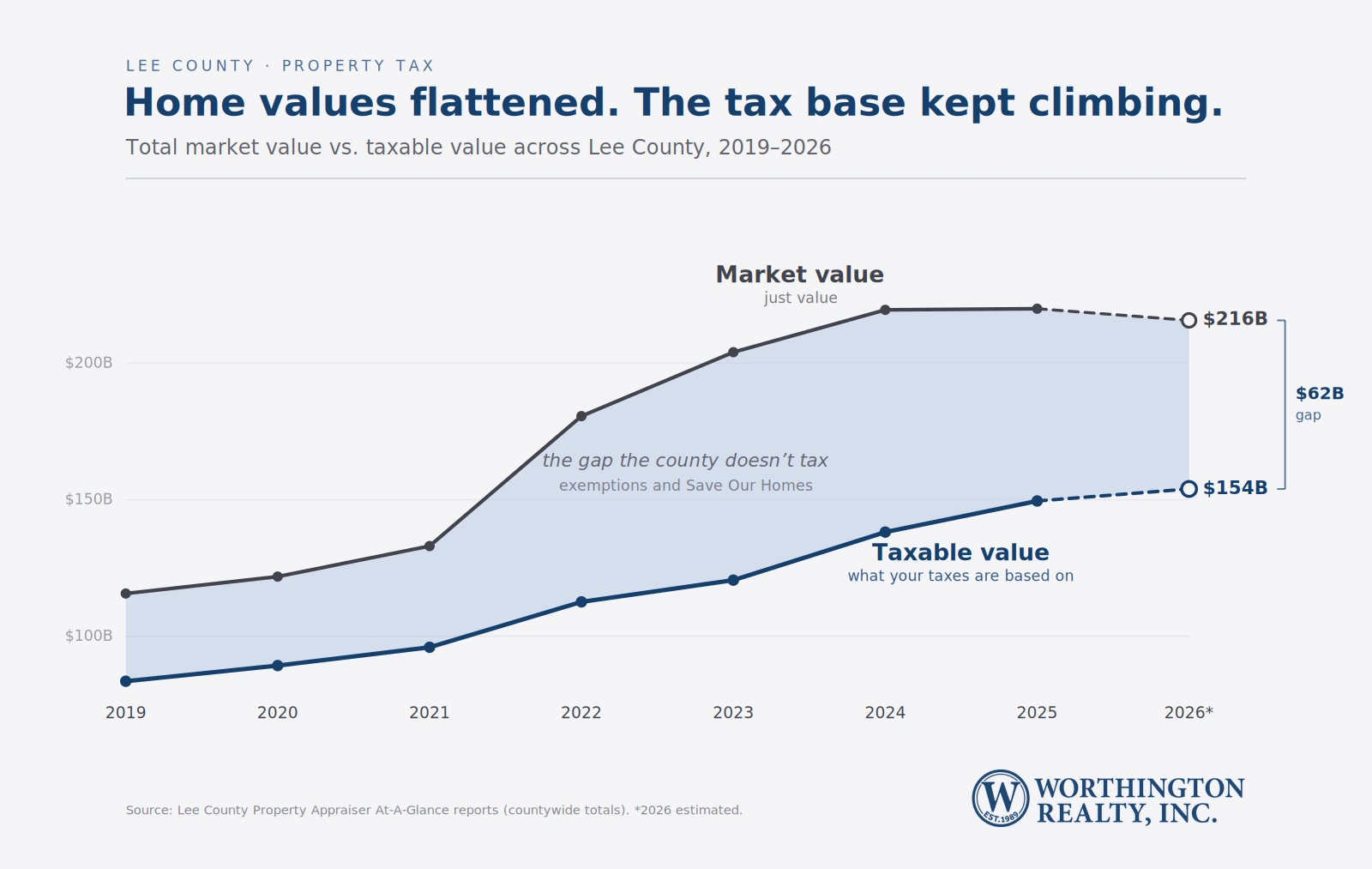
Save Our Homes is the reason. Florida voters approved the cap in 1992 and it took effect in 1995. It limits how much your assessed value can rise each year, to the lesser of 3% or inflation. If your assessed value sits below market value, it can keep climbing even when prices cool. Countywide totals also include new construction.
What it would cost local government
Lower homestead bills mean less revenue for the governments that rely on them, and the estimates have moved as the models have been reworked.
Reporting on Lee County’s own modelling put the loss at about $129.7 million and $240.8 million in June, and at roughly $121 million and $159 million after the September workshop. Later workshops have been reported lower again. These come from reporting rather than from the county’s published models, and the figures may not cover the same funds or years, so treat them as a direction of travel and check the latest workshop before quoting any of them.
Cape Coral now publishes an estimated loss of $31.1 million in year one and $56.9 million in year two, citing the state Office of Economic and Demographic Research. An earlier city figure of $46 million has been superseded.
Those are projections, not results. Governments can respond by replacing revenue, adding fees, restraining spending or reducing services, and which of those happens is a local decision that has not been made.
How to estimate your own bill
Start with your assessed value, not your market value or your purchase price. You will find it on your TRIM notice or on your parcel record with the Lee County Property Appraiser.
Subtract your exemptions to get your taxable value, remembering that schools use a different figure. Multiply each taxable value by the matching millage rate and divide by 1,000. Then add non-ad valorem charges, which are such as solid waste and stormwater, billed on a basis other than value. They do not change under this amendment.
One caution on timing. The August TRIM notice shows proposed taxes and hearing dates. It is not the final bill, and the adopted rates can differ.
Frequently Asked Questions
When would the exemption actually change my bill?
Not until 2027 at the earliest. If voters approve it, the first larger exemption applies to the 2027 tax year. You would see it on the TRIM notice in August 2027 and the tax bill in November 2027. Your 2026 bill is unaffected either way.
Would my property tax bill drop to zero?
No. The larger exemption applies only to non-school taxes. School taxes keep the current $25,000 exemption. Non-ad valorem charges, such as solid waste and stormwater, are not based on your property value and also continue.
I am moving to Florida next year. Do I get the full exemption?
Not at first. What counts is where you lived on December 31, 2026, not when you buy. If you were not a Florida resident on that date, you start with a $50,000 exemption on non-school taxes, adjusted for inflation from 2028, and the larger exemption begins with the fifth year of your exemption. A homestead first exempt in 2027 would reach it in 2031. Anyone who was already a Florida resident on December 31, 2026 gets the larger amount as soon as it takes effect, even if they buy later.
Does this help rentals, second homes or commercial property?
Not through the homestead exemption, which those properties do not receive. They would get the tighter assessment cap. The limit on how fast assessed value can rise each year for non-school taxes would fall from 10% to 5% starting in 2027.
Why did my tax bill rise when home prices fell?
Save Our Homes limits how fast your assessed value can rise, so during years of rising prices many assessed values sat well below market value. When market value dips, assessed value can keep climbing toward it. Lee County’s preliminary 2026 roll showed total just value slightly lower than the year before while total taxable value rose.
Do I need to apply for the larger exemption?
If you already hold a Lee County homestead exemption, the published guidance does not require a new application for the increase. Anyone establishing a homestead for the first time still files with the Lee County Property Appraiser, and the regular filing deadline is March 1. Confirm your own situation with the Property Appraiser.
What happens on November 3
The measure needs 60% of the vote, so a narrow lead is not enough to pass it.
If it passes, the change takes effect January 1, 2027 and first appears on the August 2027 notice and the November 2027 bill. Your 2026 bill is already set and does not change.
If it fails, the current $51,411 exemption and the 10% non-homestead cap stay as they are.
We will update this page with the result and what it means for Lee County owners.
Property tax is one line in the cost of owning a home here. If you are weighing a move, a purchase or a sale in Lee County, we will walk through the numbers for your situation and tell you what we actually see.
An agent will reach out personally within one business day. No pressure, just answers.
Get Southwest Florida updates by emailSources: enrolled text of CS/HJR 1F and the Florida Senate bill summary; ballot language filed with the Florida Department of State; Lee County Property Appraiser for 2026 exemption amounts and the 2025 certified millage; Lee County and City of Cape Coral for revenue estimates. Verified October 15, 2026. This is general information about a proposed amendment, not tax or legal advice. Confirm your own position with the Lee County Property Appraiser or a qualified tax professional.
Get the update
Free · Two quick steps · Unsubscribe anytime