

This post was written in May 2026 and has not been updated since. For current numbers, see our Southwest Florida housing market page.
Reading Lee County’s housing market through 10 years of public records
The Southwest Florida real estate market is showing signs of better balance. Pending sales, closings, and showings per listing are all trending in the right direction. Underneath those headline numbers, though, Lee County lis pendens filings have been climbing in the background, and the trend has caught the eye of investors and experienced agents. For the broader regional read on April’s market, see our May 2026 Southwest Florida market report. This piece takes a closer look at the data behind that climb, what 10 years of public records reveal about it, and what Lee County homeowners and agents should take from the trend.
Key takeaways
- The pre-COVID monthly average was 149 lis pendens filings per month in Lee County, based on four years of data from 2016 through 2019.
- The federal foreclosure moratorium suppressed filings from March 2020 through July 2021, and the equity boom helped keep filings low through 2022. Filings bottomed at 34 in May 2020.
- Filings returned to baseline in April 2023 and have run above it more consistently through 2025 and into 2026.
- 2025 averaged 193 filings per month, 29% above the pre-COVID baseline. 14 of the last 18 months have run above baseline.
- The MLS does not capture this layer of market activity. Lis pendens filings offer a separate read on owner financial pressure that closed sales and inventory counts cannot fully show.
A lis pendens is a warning, not a final outcome
A lis pendens is a Latin phrase meaning “suit pending.” When someone files a lawsuit involving real property in Florida, the court records a lis pendens against the property in the county’s official records. This puts the public on notice that the property’s title is now subject to litigation.
The most common residential trigger is a mortgage foreclosure lawsuit filed by a lender. The second most common is an HOA or condo association lien enforcement action. The dataset also includes commercial mortgage filings, construction lien actions, and other civil cases involving property.
What a lis pendens does not mean
A lis pendens does not mean the property has been foreclosed. It does not mean the owner has been evicted. It does not mean a sale has happened. Florida uses a judicial foreclosure process, which means a court must hear the case before any final action. The typical timeline from lis pendens filing to completed foreclosure sale often runs roughly 12 to 24 months, depending on the court timeline, whether the case is contested, and whether the owner resolves the issue before sale. Many cases never reach that point. The owner may cure the default, sell the property privately, negotiate a modification, or reach another resolution.
Today’s filings sit at a fraction of the 2008 crisis volume
Before looking at the post-2016 detail, the longer view is worth a moment. Lee County’s lis pendens activity through the 2008 housing crisis ran at a scale that bears no resemblance to today’s numbers. The Lee County Clerk of Court’s records show 29,795 filings in 2008 alone. The following two years added another 35,000 combined. Lee County recorded roughly 81,000 lis pendens filings between 2007 and 2010.
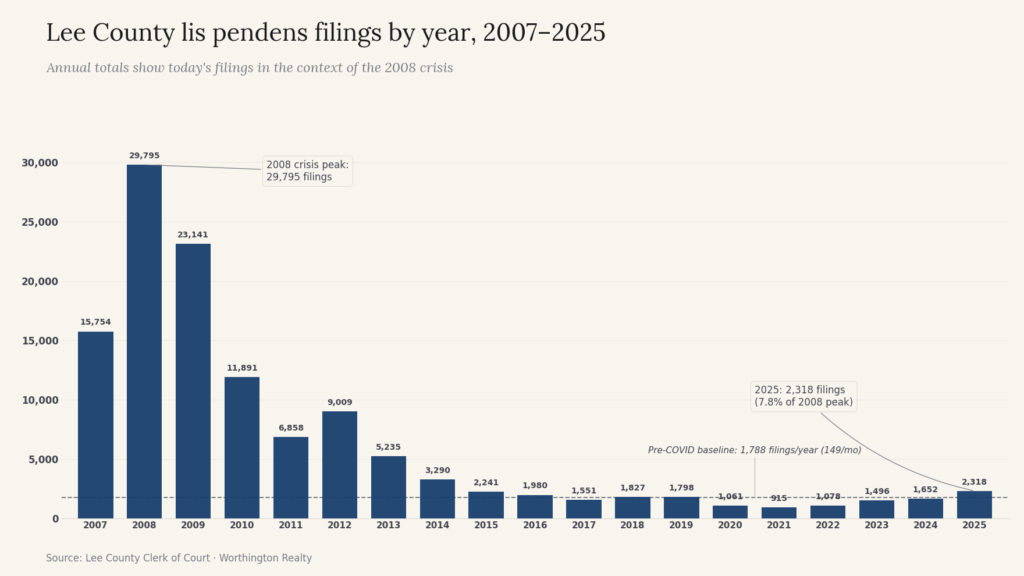
2025 totaled 2,318 filings, or roughly 7.8% of the 2008 peak. The current pace is meaningfully above the pre-COVID baseline, but it sits more than ten times below the crisis-era volume. The point here is not to dismiss what the recent data shows. It is to be clear about what scale of activity actually looks like when a housing market enters genuine distress, and how far the current numbers sit from that scale.
The rest of this piece focuses on the post-2016 period, where the more useful comparisons live. The 2008 cycle is the warning sign reference. Today’s data is a different conversation.
Lee County lis pendens filings have climbed back above their pre-COVID baseline
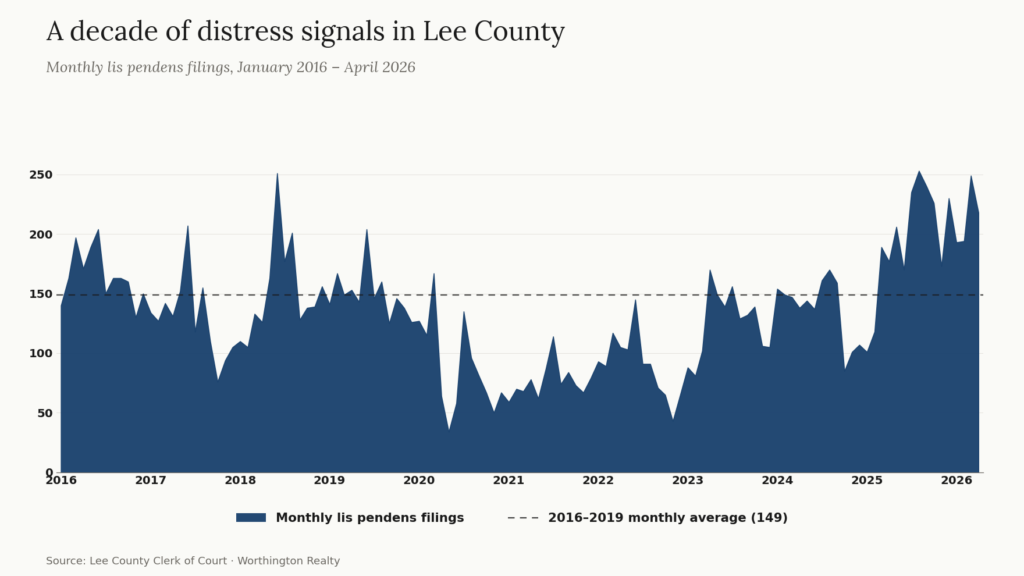
We pulled 16,699 unique Lee County lis pendens filings from January 2016 through April 2026. Across the four pre-pandemic years from 2016 through 2019, the county averaged 149 filings per month. That figure is the cleanest baseline available for what Lee County looked like before the COVID-era disruptions, and it anchors the analysis that follows.
Federal action and rising equity froze the data
The pandemic-era federal foreclosure moratorium ran from March 2020 through July 2021, suppressing new filings nationwide. Lee County hit its low of 34 filings in May 2020. The suppression continued well past the moratorium itself. Even after the federal program ended, filings stayed low through 2022 because rapidly rising home values gave most owners under pressure a way out through voluntary sale rather than foreclosure. The 2022 monthly low of 43 in November 2022 was not a market signal. It was the bottom of an artificially suppressed cycle.
Monthly filings did not return to the 149 baseline until April 2023. Since then, they have continued upward. August 2025 hit 253 filings, the highest single month in the 10-year series. What makes 2025 and 2026 different from earlier above-baseline months is the clustering. June 2018 hit 251 once. Today’s data shows 14 of the last 18 months above baseline, with 11 of them more than 25% above it.
Inventory rebuilt and filings rose together
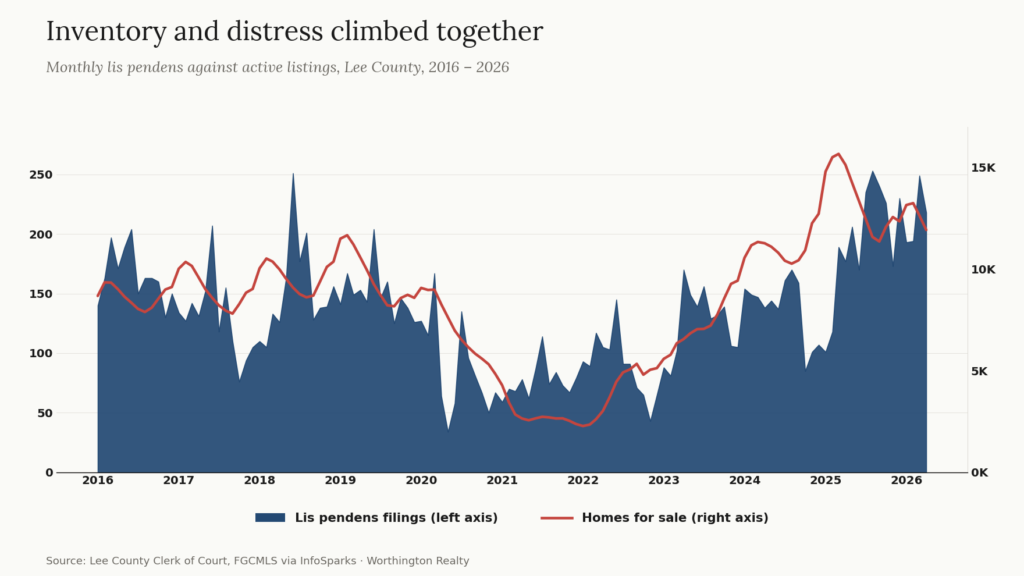
Lee County had about 2,375 active listings in December 2021. As of April 2026, that figure stands near 12,000, with a peak above 15,600 in March 2025. The two series have moved together from 2023 forward, with filings and inventory pressure rising at the same time. A larger inventory environment can also make voluntary exits harder to execute, especially for owners who need to sell quickly.
Closings improved in 2026 while filings kept climbing
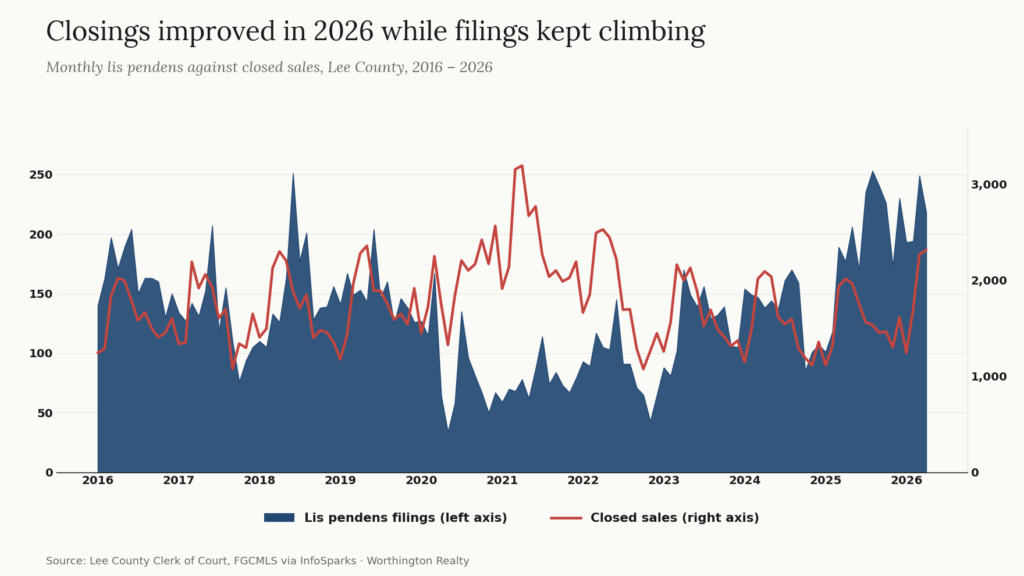
Lee County averaged roughly 1,800 closed sales per month in 2022, then closer to 1,540 per month in 2024. 2025 ran slightly ahead of 2024, and 2026 is running ahead of 2025. April 2026 closed sales hit 2,317, up roughly 15% from April 2025, with the broader regional improvement covered in our May 2026 Southwest Florida market report.
Lis pendens filings, by contrast, have more than tripled from their 2022 low. The two series have decoupled. Buyers are returning to the market, while legal distress remains above baseline. The rise in filings is not a byproduct of a frozen buyer pool.
Slower sales gave distressed owners less room to exit
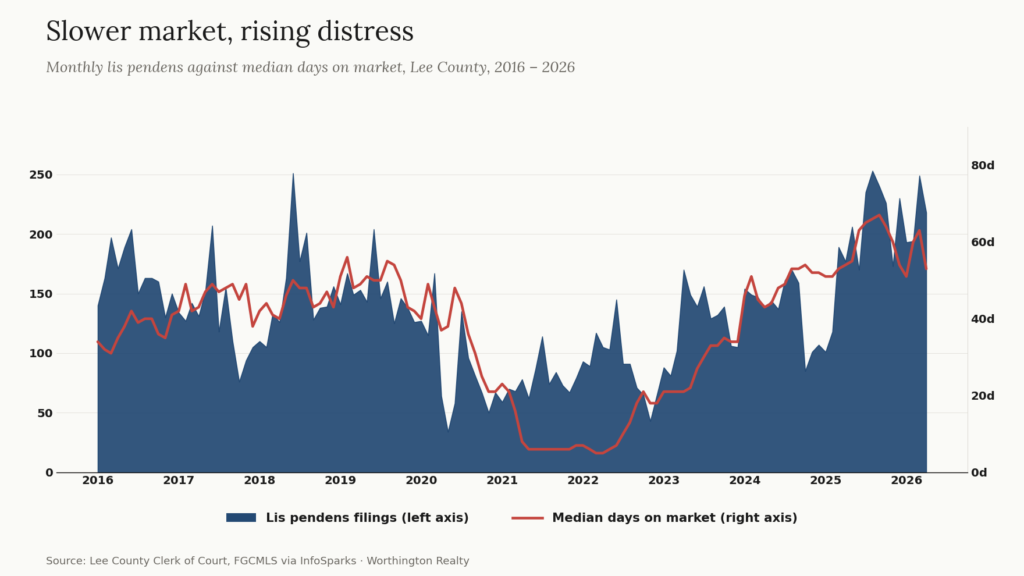
Median days on market in Lee County bottomed at five days during the spring 2022 frenzy and has climbed to between 50 and 65 days across 2025 and 2026. Lis pendens filings moved upward over the same span. When homes take longer to sell, owners under financial pressure have less runway to execute a voluntary exit before foreclosure becomes the path forward. The simultaneous rise of DOM and filings fits that mechanism.
Prices softened from peak as Lee County lis pendens filings kept climbing
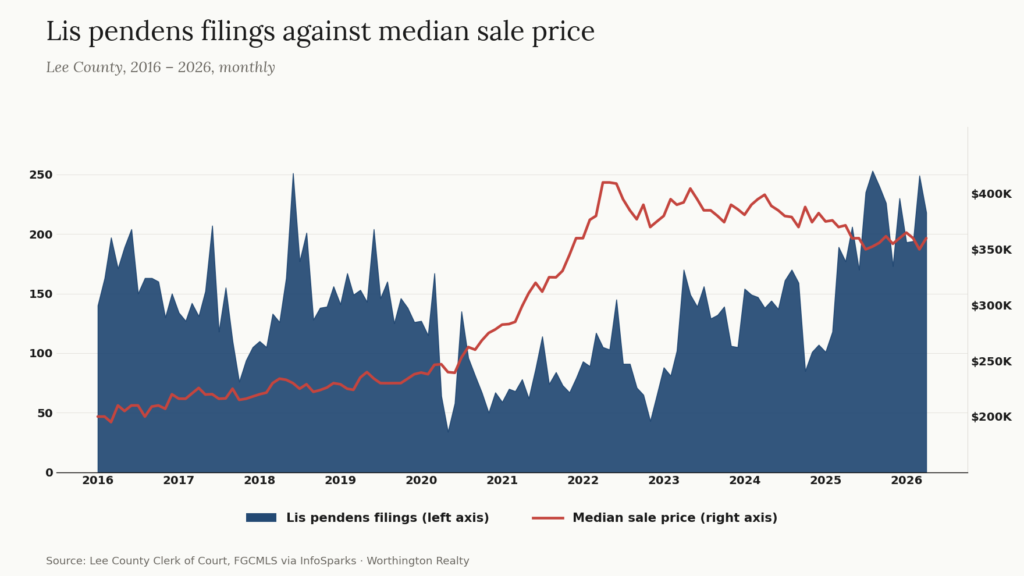
The Lee County median sale price climbed from roughly $200,000 in early 2016 to a peak of $410,000 in April 2022, then softened to about $360,000 by April 2026. The two series did not move in lockstep. During 2020 through 2022, prices climbed sharply while filings collapsed. From 2023 forward, prices have moved sideways or softened while filings have continued upward.
Rising filings in 2025 and 2026 are happening against a backdrop of softening prices, not falling ones. Home values remain well above pre-COVID levels but below the 2022 peak.
The timing of the current run also lines up with the peak-price ownership window. Lee County’s median sale price climbed above $390K in early 2022 and stayed near peak levels through much of the following two years before softening. Owners who bought during that window paid peak-cycle prices and are now carrying those purchases in a different insurance, tax, and interest-rate environment. For some newer owners, the equity cushion may be thin or already gone.
What the trend means if you live, buy, or sell in Lee County
For sellers
Pricing strategy carries more weight in 2026 than it did in 2024. Buyers have more competing inventory to compare, and the market includes more visible signs of owner pressure. Listings priced to current market conditions are more likely to sell. Listings priced to 2022 peaks tend to stay on the market. For sellers who bought at peak with low down payments, current pricing may not cover transaction costs.
For buyers
Increased filing activity expands the pool of motivated sellers across Lee County, including pre-foreclosure short sales. These transactions require patience and comfort with longer timelines.
For investors
The Lee County Clerk of Court’s Official Records search is the starting point for tracking specific filings. Filter by Doc Type LIS PENDENS and date range to surface recent activity. Most filings name the property’s legal description. The pre-foreclosure window from initial filing to scheduled sale typically runs 12 to 24 months. That window is long enough to evaluate a property, contact the owner through proper channels, and structure a short-sale offer if the deal fits. Filing volume is trending higher into the second half of 2026, with implications for short-sale supply and possible auction inventory.
For agents
A lis pendens filing is not a foreclosure. Agents who can speak to both the MLS data and the public-records picture bring more useful context to listing conversations and buyer consultations.
Frequently asked questions
No. A lis pendens is a public notice that a lawsuit involving the property has been filed. The case still has to work through the court before any foreclosure sale. The typical timeline from filing to sale runs 12 to 24 months.
Lis pendens filings have moved above their pre-COVID baseline, suggesting more legal action than before the pandemic but far less than the 2008 to 2012 crisis era. Completed foreclosure sales lag filings and are a separate measure.
No. Current Lee County filing rates are above the 2016 through 2019 average but well below post-2008 crisis levels. The 2008 cycle was driven by loose lending, high-risk loan structures, and many borrowers starting with little or no equity. Today’s distress is different. Many owners under pressure bought during the peak-price period from 2022 through 2024, and prices have since softened roughly 10% to 12%. For some newer owners, the equity cushion may be thin or already gone.
Not directly. Lee County home values have softened from their 2022 peak but remain well above pre-COVID levels. Filing activity reflects financial pressure on individual owners. It may increase the supply of motivated sellers, but it does not automatically drive broader price moves.
The Lee County Clerk of Court’s Official Records search allows public access to all recorded documents, including lis pendens filings. A title search performed during a real estate transaction will also reveal any active filings.
Final thoughts
Lee County’s housing market in 2026 is not the market of 2022. Lis pendens filings moved above their pre-COVID baseline and have remained above it in most recent months. More Southwest Florida owners are under pressure than the MLS alone reveals. Buyers, sellers, and agents who understand both pictures are better positioned to make sound decisions.
Search homes across Southwest Florida →
Schedule a 15-minute conversation to discuss your situation →
Most homeowners feel overwhelmed when it’s time to move. At Worthington Realty, we provide personalized guidance and clear communication so that you feel heard, valued, and confident in your decisions.
