


Earning trust starts with understanding the room you’re walking into.
You’re sitting at a seller’s dining table. She’s printed out three Zillow estimates and an article about commission lawsuits. She hasn’t asked a question yet. She’s waiting to see what you do first.
Not every appointment starts here. The relationship-first practices discussed earlier in this series reduce how often you walk in cold. But every agent eventually sits across from someone with no shared history and no accumulated trust. This is what that room looks like and how professionals earn their way through it.
Key Takeaways (TL;DR)
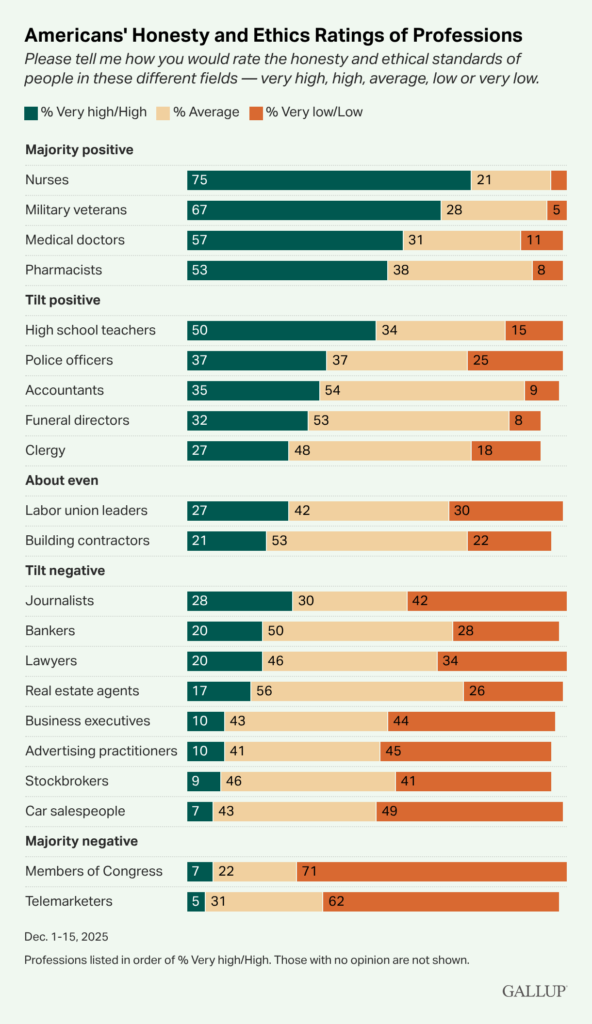
- Only 17% of Americans rate real estate agent ethics as high or very high (Gallup, December 2025). That’s below lawyers.
- The trust deficit has roots that no individual agent created, but it also has a professional response that any individual agent can choose.
- Some agents respond with armor, avoidance, or resentment. None of these build trust.
- Trust is earned through four things in order: posture, vulnerability, competence, consistency.
Buyers and Sellers Can Be Cautious Before You Even Sit Down
The person across from you arrived carrying every bad agent story they’ve heard from a friend, every joke about pushy salespeople, every headline about the industry.
Gallup’s December 2025 honesty and ethics poll puts numbers to what agents already feel: only 17% of Americans rate real estate agent ethics as high or very high, with just 3% saying “very high.” For context, nurses sit at 75% and doctors at 57%. Even lawyers, a profession people also love to distrust, come in at 20%.
Gallup’s 2025 average across all professions hit an all-time low. Trust is harder to earn in every professional relationship right now, which means agents who are intentional about earning it aren’t just overcoming an industry problem. They’re working against a societal one.
The most telling number, though, isn’t the 17%. It’s the 56% who said “average.” Most people don’t think agents are dishonest, but they don’t think agents are especially ethical, either. The majority feels something closer to indifference, which is actually harder to work with than hostility because there’s nothing to push against.
What the Trust Deficit Means in Practice
Stephen M.R. Covey calls this a trust deficit. It means you walk into the room already owing something you haven’t had a chance to earn yet. Think of it like opening a new bank account and finding an insufficient funds notice already waiting. Even though you didn’t make the withdrawals, the account is still in your name.
Not every client arrives with a wall up. The relationship-first work from earlier in this series can lower it before you sit down. But when there’s no shared history yet, this is the room you’re in.
Why Some Buyers and Sellers Don’t Trust Real Estate Agents
The skepticism comes from three places, and knowing what they are helps you respond instead of reacting.
Commission-Based Advice Creates Doubt
You make money when the deal closes, and the person sitting across from you knows that. So every recommendation carries a question underneath it: is this what’s best for me, or is this what gets you paid? Any reasonable person in that position would ask the same thing. Look at the bottom of the Gallup ranking: real estate agents, stockbrokers, car salespeople, members of Congress. Every one involves someone who profits from the outcome they’re recommending. The structure means nobody in a commission-based relationship gets trust by default. The agents who earn it are the ones who make their reasoning visible, walking sellers through the comparable data so the client can see how the recommendation was reached rather than being asked to take the number on faith.
Low Barriers to Entry Make Credibility Harder to Establish
In Florida, a real estate license takes 63 hours of pre-license education and a state exam. Someone who passed last Tuesday can represent a family on the biggest financial decision of their lives. A lot of people enter the business underprepared, give a few clients a bad experience, and leave within two years. The clients remember, and that reputation sticks to every agent who comes after. When the entry bar is that low, the agents who stay carry a heavier burden to show they belong above it.
Industry Language Frames Clients as Targets
Leads, prospects, pipeline, conversion, capture, close. That vocabulary frames people as something to be captured rather than someone to be served. Your clients may never hear you say those words, but they can feel the difference between an agent who sees them as a person and one who sees them as a transaction in progress. It’s worth paying attention to whether the language you use internally is shaping how you show up externally. An agent whose CRM is built around names and relationships may approach conversations differently than one whose system starts with ‘leads’ and ‘pipeline.’ That’s not a rule. It’s something to notice.
None of these pressures are within your control, yet all of them are shaping the room before you speak.
Why Most Agents Struggle to Talk About Trust
After enough listing appointments, you start to recognize when someone has already decided you’re one of the bad ones. That hits your identity, and the natural response is to protect yourself.
That protection shows up in three ways.
The first is performing. The agent shows up with a printed portfolio, a slide deck, and a rehearsed pitch. They spend the first twelve minutes on their production numbers, their awards, their ranking in the county, and a graph of their year-over-year growth. At minute thirteen, they ask the seller what their timeline is. By then, the seller has already decided this meeting is about the agent, not about their house.
There’s nothing wrong with a track record. The difference is whether your numbers explain what you can do for the client or what you’ve done for yourself. “I’ve closed 47 transactions” is a résumé. “I’ve worked with 47 families in this neighborhood, so I can show you exactly what buyers are responding to” is something she can actually use. Same number, but only one of them is about her.
The second is avoiding. The agent pretends the elephant isn’t in the room, never acknowledging that clients have good reasons to be careful. This reads as either clueless or dishonest, and neither builds anything.
The third is resenting. “I’ve been ethical my entire career and people still look at me sideways.” That bitterness leaks into the conversation as impatience, or a clipped tone when the client asks a reasonable question, and the wall goes higher.
What the Professional Response Looks Like
All three are understandable, and all three make it worse. The professional response means holding two things at once: this industry has earned some of its reputation, and I’m a trustworthy professional. Agents who can only hold one get stuck, either defending the industry reflexively or absorbing the criticism until they start doubting themselves. The professional holds both, staying honest about the environment without letting it define them. That’s what self-awareness is for. When you know who you are and how you operate, you don’t need to perform. Clients can feel the difference, and that’s where trust starts.
How Real Estate Professionals Earn Trust
That insufficient funds notice works in both directions. When trust is low, everything gets harder. Conversations take longer. Decisions stall. People second-guess good advice. That’s the room you’ve been reading about. But it also means that when clients walk in expecting to be sold, the agent who operates with genuine integrity stands in a category many clients have never encountered.
Trust gets built through four things, and the order matters.
Posture comes first.
The client is the center of the conversation, not the backdrop for your credentials. The simplest version of posture is asking the client what matters to them before you explain what you can do for them.
The seller with the Zillow printouts didn’t bring them because she loves research. She brought them because last time, she was the less-informed person in the room and it cost her. The printouts are her shield. The professional move isn’t to overpower them with better data. It’s to make her feel like she doesn’t need one.
Your credentials come later because the client needs to feel like this is about them before they’ll listen to anything about you. If you’re early in your career, this is actually easier. You don’t have a résumé to hide behind, which means the client gets your full attention by default.
Vulnerability earns what credentials can’t.
Trust starts when someone goes first with honesty, even when it’s risky, and in the agent-client relationship, that someone is you. The standard examples are telling a seller their price is too high or telling a buyer this isn’t the right house. Those are real, but the harder version is quieter. The seller’s home needs $15,000 in work before it’s ready to list. The agent says so, and tells the seller they won’t take the listing until the work is done. The seller thanks them for their honesty and hires someone else. Six weeks later, after that agent can’t get an offer at the inflated price on an unprepared house, the seller calls back.
Sometimes they don’t. The point isn’t the callback. The point is that you told the truth because it was the right recommendation, and over a career, that compounds even when any single conversation costs you. That’s what earned vulnerability looks like: it has a cost, a consequence, and no guarantee. One warning: this only works if you mean it. Performed vulnerability is just manipulation with better packaging, and when the person you’re talking to catches it, the damage is worse than if you’d never tried. Someone who hears “I’m going to be honest with you” and then watches the agent steer toward the close anyway remembers. The next agent who actually means it pays for that.
Competence backs up what vulnerability promises.
Being honest without knowing your stuff just makes you unprepared. Competence lands differently depending on when it appears, though. When they already feel heard, your market knowledge and contract expertise feel like help. When you lead with competence before establishing any connection, the same knowledge can feel like “don’t question me.” The knowledge is identical, but the trust it builds depends entirely on when it appears in the relationship.
A seller mentions they’re worried about pricing too high and sitting on the market. The agent who’s already been listening can say “here’s what I’m seeing in the data” and the seller leans in. The same sentence from an agent who opened with a market presentation might just get a polite nod and a “we’ll think about it.”
Consistency turns clients into advocates.
A single listing presentation can start trust, but it can’t sustain it. What sustains it is the accumulation of small, unremarkable moments over months and years. The text about something that matters to them beyond real estate. The market update sent because you thought of them. The check-in after closing that proves you weren’t just around for the commission.
But the moment that turns a client into an advocate usually has nothing to do with real estate. A storm rolls through and you text to check on them before they call you. You drive past their house, notice the landscaping looks great, and tell them. There’s no deal attached, no commission coming, no reason to reach out other than you thought of them. That’s when the client stops thinking of you as their agent and starts thinking of you as their person.
A client who trusts you at that level refers you without being asked, and that referral arrives with less skepticism because someone they trust already vouched for you. After enough of those referrals, you stop fighting the insufficient funds notice with every new prospect and start benefiting from the trust you’ve already built.
Common Questions About Earning Trust in Real Estate
No single agent can fix the industry’s reputation, but you can make it irrelevant in your own practice. Every agent who builds trust through honesty and competence creates a client who tells a different story about what working with an agent is like. That story spreads. It doesn’t move the Gallup numbers, but it builds something more useful: a referral network where trust is already established before the first conversation.
Earning trust means being willing to lose the deal when honesty requires it. The performed version says the right words while still steering toward the close, and clients can feel the difference. When they catch it, the damage is worse than if you’d never tried. The test is simple: would you give the same advice if you weren’t getting paid?
Yes, and often faster than expected. The people you serve well in your first year remember how you made them feel long after closing. When they hear someone mention buying or selling, your name comes up. That tends to start happening within the first few years for agents who stay consistent.
Your Daily Practice Determines the Outcome
You inherit a trust deficit the day you get licensed. You didn’t create it, but you’re still responsible for how you respond.
The response is to understand why the guard is up and be honest about the environment you work in. Then earn trust anyway through posture, vulnerability, competence, and consistency, one client at a time.
The next piece in this series takes this into daily practice: what professionalism actually looks like when the theory meets a Tuesday afternoon.
If you’re exploring what a real estate career could look like and want to learn more about Worthington Realty, you can read about joining our team in Southwest Florida or contact us to start a conversation.
Agent Success Series
This article is part of the Worthington Realty Agent Success Series, a 14-part series exploring what it actually takes to build a sustainable real estate career in Southwest Florida.
Overview: How to Start a Real Estate Career in Southwest Florida
- The Hard Truths About Starting a Career in Real Estate
- The Financial Realities Most New Agents Aren’t Prepared For
- The Real Patterns Behind Sustainable Real Estate Careers
- Become the Agent They Call First by Building Trust in Real Estate
- What a Productive Day Actually Looks Like for a Real Estate Agent
- Succeeding in Real Estate Without Social Media Mastery
- Your Database Is Your Business
- How New Real Estate Agents Get Their First Clients
- Real Estate Agent Stress Requires Skills Nobody Taught You
- Building a Real Estate Career That Fits How You’re Wired
- Earning Trust in Real Estate Is a Professional Skill ← You are here.
- The Professional’s Code in Action
- Real Estate Agent Burnout Runs Deeper Than the Market
- Building a Real Estate Career That Lasts in Southwest Florida
